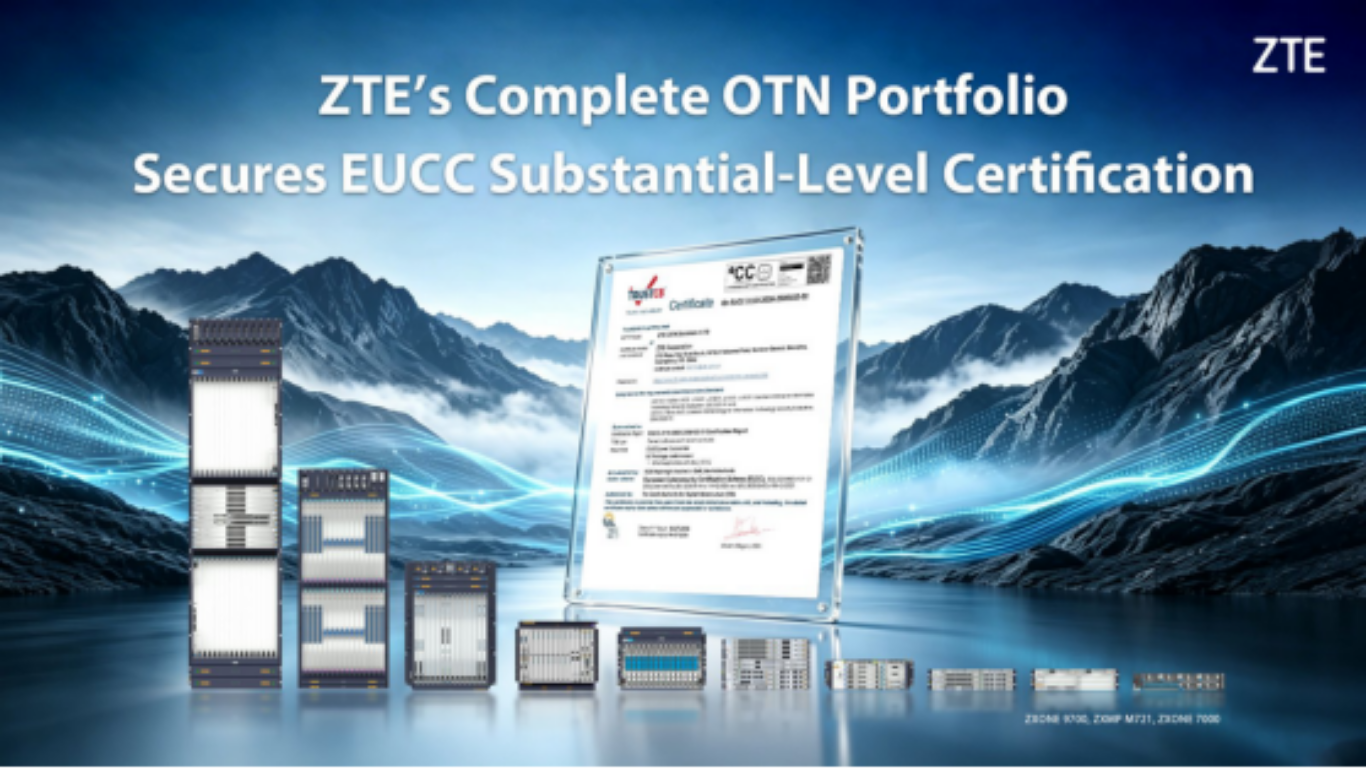
ZTE corp secured an important compliance milestone when its complete optical transport network portfolio obtained EUCC substantial-level certification. The recognition strengthens the company’s position in Europe and sends a clear signal that secure, verified infrastructure is becoming a core requirement in modern transport networks.
For operators, certification is not just a badge. It is a practical indicator that a product family has been tested against demanding criteria covering security, design, implementation, and lifecycle trust. In this case, the result also matters because the company says the complete OTN portfolio is the first of its kind to achieve this level of recognition.
Why EUCC Certification Matters
The EUCC framework is closely associated with trust in digital infrastructure. It is designed to evaluate whether products meet substantial security expectations in a market where resilience, compliance, and transparency are increasingly important. That makes the certification especially meaningful for optical transport, which sits at the heart of many critical networks.
As traffic grows and service environments become more complex, operators want assurance that backbone systems are not only fast and scalable but also secure over the full product life cycle. The certification therefore speaks to both technical performance and governance readiness.
This is especially relevant in Europe, where operators often need to demonstrate that network choices can meet strict expectations from regulators, enterprise customers, and public-sector stakeholders. A recognized certification gives those stakeholders a more concrete basis for evaluating infrastructure risk.
A Complete Portfolio, Not a Single Product
The certified scope covers the company’s complete OTN portfolio, including flagship platforms such as ZXONE 9700, ZXMP M721, and ZXONE 7000. The broader message is that security validation was not limited to one isolated device. It covered a family of products that supports multiple layers of optical transport deployment.
That breadth matters because operators typically want consistency across core, metro, and access scenarios. A complete portfolio can reduce operational fragmentation and make it easier to standardize security expectations, deployment planning, and long-term maintenance across the network.
Security Validation Across the Full Lifecycle
According to the source information, the evaluation looked beyond basic functionality. It covered design and development, supply chain controls, vulnerability remediation, security testing, physical protection, and operation-and-maintenance assurance. In other words, the certification reflects trust in the product lifecycle as a whole.
The framework also aligns with international evaluation standards such as ISO/IEC 15408 and ISO/IEC 18045. That alignment is important because it gives operators and procurement teams a familiar basis for comparing risk, verifying quality, and choosing infrastructure that can support long-term network reliability.
Lifecycle validation is important because security conditions continue changing after deployment. Vulnerabilities may emerge, supply chains may shift, and operational processes may evolve. By including these dimensions in the certification scope, the assessment reflects the real conditions under which transport products must operate.
What It Means for European Operators
For European buyers, the certification can simplify the conversation around vendor trust. Optical transport networks often support government services, enterprise backbones, and other sensitive use cases. A substantial-level certification helps show that the platform has undergone a rigorous assessment rather than a superficial review.
The result may also improve confidence in deployment planning. When security, compliance, and operational continuity are verified together, operators can focus more on architecture and service delivery and less on unresolved questions about infrastructure credibility.
It also helps operators think about future upgrades. Optical transport networks must carry growing data center, cloud, government, and enterprise traffic. A certified portfolio gives network planners a more stable foundation for expanding capacity while keeping security and compliance requirements in view.
A Broader Signal for Market Trust
The recognition also fits a larger pattern in the company’s positioning. Trusted infrastructure is central to next-generation digital transformation, and optical transport is a key part of that story because it links data centers, metro networks, and backbone environments into one dependable fabric.
In that sense, the certification is not simply about a product line passing a test. It shows that the company is investing in the kind of assurance that modern networks now require. Security, compliance, and operational confidence are becoming inseparable from performance and scale.
Conclusion
The EUCC substantial-level certification gives the company a strong reference point in Europe and beyond. By certifying its complete OTN portfolio, the company demonstrated that secure optical transport can be built as a full lifecycle capability, not as an afterthought.
For operators, the result is useful because it links product choice with network trust. For the company, it reinforces a strategy built around reliable infrastructure, broader market credibility, and the ability to support digital networks that must stay secure while they continue to scale. It also creates a practical reference for future procurement decisions.